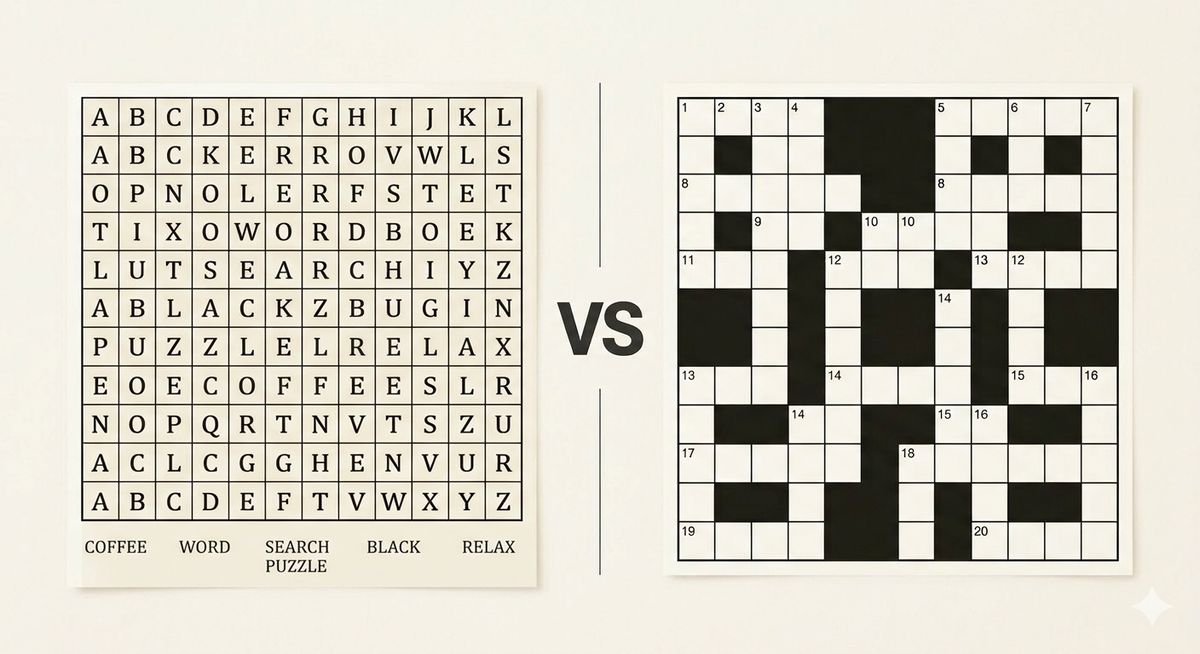
Word search or crossword — which one should you be doing? If you've ever stood in a bookstore flipping between two puzzle books, or argued with a friend about which game is "harder," you're not alone. It's one of the most common questions I get as a puzzle book publisher.
The honest answer is that they're different exercises for your brain, not better or worse versions of the same thing. But the differences matter — especially if you care about cognitive health. Let me walk you through what each puzzle actually does, what the research says, and how to pick the right one for you.
How word search and crossword puzzles work differently
A word search gives you a grid of letters and a list of hidden words. Your job is to scan the grid and find them. Words can run horizontally, vertically, diagonally, forward, and backward. There are no clues to interpret — just pattern recognition and visual scanning.
A crossword gives you an empty grid and a set of clues. You have to figure out the answer to each clue and fit it into the grid so that intersecting words share letters. This requires vocabulary recall, lateral thinking, general knowledge, and sometimes a tolerance for deliberately tricky wordplay.
The key distinction: word search is primarily a visual-perceptual task (scanning, recognizing patterns), while crossword is primarily a verbal-retrieval task (recalling knowledge, making connections). Both involve language, but they engage your brain through completely different pathways.
What the research says about brain benefits
The University of Exeter and King's College London conducted one of the largest studies on this topic, analyzing data from over 19,000 adults aged 50 and older. Their finding: adults who regularly did word and number puzzles performed significantly better on cognitive tests measuring attention, reasoning, and memory. Regular puzzle users showed brain function equivalent to people ten years younger on short-term memory tests.
What's important is that the researchers found statistically significant benefits for both word puzzle users and number puzzle users. The more frequently participants engaged with either type, the better their cognitive test scores — suggesting that a consistent habit matters more than the specific format.
A separate study published in NEJM Evidence compared crossword puzzles directly against computerized brain training games in 107 people with mild cognitive impairment. The crossword group showed greater cognitive improvement at both 12 weeks and 78 weeks, plus less brain shrinkage on MRI scans. To put this in perspective: the FDA approved memory-enhancing medications for Alzheimer's based on a two-point improvement on the same 70-point cognitive scale used in this study, and 37% of the crossword participants achieved at least that level of improvement.
However, neurologist Dr. Robin Hsiung at UBC's Centre for Brain Health makes an important point: different puzzles train different cognitive domains. A word puzzle strengthens the brain area that controls language and pattern recognition, while a number puzzle like Sudoku works mathematical reasoning. Doing only one type means you're only exercising one part of your brain.
His advice is straightforward: do multiple types of puzzles, not just your favorite one.
Word search strengths
Word search puzzles are often underestimated. Because they don't require specialized knowledge, people assume they're "too easy" to be beneficial. But research suggests several specific cognitive advantages.
Visual scanning and attention. Finding words hidden in a grid of random letters requires sustained visual attention — the same skill you use when scanning a crowded parking lot for your car or reading a dense document for specific information. This engages your brain's visual-spatial processing systems.
Pattern recognition. Your brain learns to detect letter sequences embedded in noise. This is a form of perceptual learning that strengthens neural pathways involved in reading and visual processing.
Accessibility and consistency. Because word search puzzles don't require external knowledge, they're less likely to cause frustration and more likely to become a sustained habit. Research consistently shows that regularity matters more than difficulty — a daily easy puzzle beats an occasional hard one.
Stress reduction. The flow state that comes from scanning a grid is genuinely relaxing. Word searches require enough focus to quiet a busy mind but not so much effort that they become stressful. Research suggests that lowering chronic stress through calming activities supports overall brain health — and a daily puzzle habit is one low-effort way to build that into your routine.
Crossword strengths
Crossword puzzles engage different — and in some ways more demanding — cognitive skills.
Verbal recall and vocabulary. Solving clues forces you to retrieve words from long-term memory based on vague or indirect hints. This exercises your brain's language networks more intensively than finding a word you can already see.
Problem-solving and reasoning. Crossword clues often require lateral thinking. A clue like "flower" might mean a river (something that flows), not a plant. This kind of misdirection strengthens cognitive flexibility.
General knowledge reinforcement. Good crosswords draw from history, science, geography, pop culture, and language. Each puzzle is a mini quiz that exposes you to information you might not encounter otherwise.
The strongest research support. The NEJM Evidence study that showed crosswords outperforming computerized brain games is one of the most rigorous studies in this space. If you're choosing one puzzle type specifically for cognitive health, crosswords have the edge in published evidence — though the research on word puzzles is also positive.
The real answer: do both
Dr. Hsiung's advice is the most practical takeaway from the research. Since different puzzles train different cognitive domains, the best strategy for brain health is variety. A word search works your visual scanning and pattern recognition. A crossword works your verbal recall and reasoning. Sudoku works your logic and number sense.
If you enjoy word searches, keep doing them — but consider adding a crossword or Sudoku to your routine once or twice a week. If you're a crossword devotee, a word search book can be a relaxing change of pace that still keeps your brain engaged.
The worst option, according to UW Medicine neuropsychologist Dr. Justin Miller, is sitting passively for hours. Almost any mentally engaging activity — puzzles, learning an instrument, reading, even a new recipe — is better than passive screen time.
Which one is harder?
This comes up constantly, and the answer depends on the specific puzzle. A Monday New York Times crossword is significantly easier than a themed 20×20 word search grid with 40 hidden words. A standard newspaper crossword is harder than a basic kids' word search.
In general, crosswords are considered more mentally demanding because they require knowledge retrieval — you either know the answer to a clue or you don't. Word search difficulty scales with grid size, word count, and direction rules. A well-designed word search with diagonal and backward words on a large grid can genuinely challenge an experienced solver.
My perspective as a publisher: difficulty is less important than enjoyment. The puzzle that keeps you coming back every day is the one that benefits your brain the most. Research backs this up — consistency is the strongest predictor of cognitive benefit, regardless of puzzle type.
How to get started with both
If you're primarily a word search person and want to try crosswords, start with Monday-level newspaper crosswords or a beginner crossword book. Don't jump to the Saturday New York Times — that's designed to frustrate even experienced solvers.
If you're primarily a crossword person and want to try word search, look for books with themed word lists and large grids (18×18 or larger). Random-word puzzles on small grids won't challenge you. Themed puzzles on 20×20 grids — where every word relates to a specific topic — offer a more engaging experience. You're not just finding words; you're exploring a subject.
For the best cognitive benefit, aim for at least 15-20 minutes of puzzle time daily, mixing types throughout the week. The Exeter/King's College research showed that frequency was directly correlated with cognitive performance — the more often participants did puzzles, the sharper their results.
Frequently asked questions
Are word search puzzles good for your brain? Yes. Research from the University of Exeter and King's College London shows that regular word puzzle users have brain function equivalent to people ten years younger on memory tests. Word searches specifically exercise visual scanning, pattern recognition, and sustained attention.
Which is harder, crossword or word search? Generally crosswords are more mentally demanding because they require knowledge recall and lateral thinking. However, difficulty varies widely — a large themed word search can be just as challenging as an easy crossword. The right difficulty level is one that challenges you without causing frustration.
Can doing puzzles prevent dementia? No single activity can prevent dementia. However, research published in JAMA found that frequent participation in mentally stimulating activities — including puzzles — was associated with a reduced risk of dementia. The Alzheimer's Society recommends puzzles as part of a broader strategy that includes exercise, social engagement, and healthy eating.
Should I do the same puzzle every day or switch types? Switching types is better for overall brain health. Neurologist Dr. Robin Hsiung recommends doing multiple puzzle types because each one trains different cognitive domains. Doing only crosswords strengthens language recall but won't exercise your visual-spatial processing — and vice versa.
How long should I spend on puzzles each day? Research participants who showed cognitive benefits typically engaged with puzzles for 15-30 minutes daily. Even a single puzzle session per week showed measurable benefits compared to non-puzzlers, but daily engagement produced the strongest results.
Enjoy puzzles? Get 80 free ones.
Join the Hazel Woods email list for free printable word search puzzles, new book announcements, and exclusive giveaways.
Claim Free Puzzles