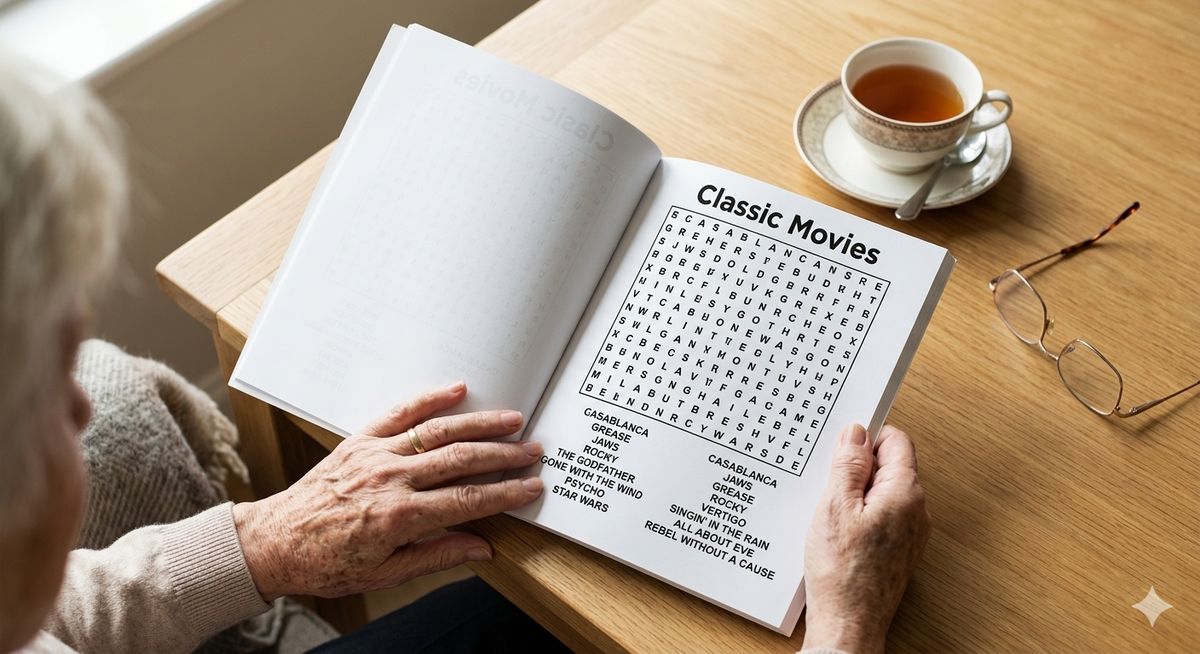
Buying a word search book for a senior — whether for yourself, a parent, or a loved one in care — is more personal than most people realize. The wrong book can be frustrating rather than fun. A grid that's too small, words that are too obscure, or a difficulty level that doesn't match the person's abilities can turn what should be a relaxing activity into a source of discouragement.
I've published over 30 word search books and hear regularly from adult children buying for parents, caregivers looking for activities for residents, and seniors shopping for themselves. The questions are always the same: Is the print really large enough? Will the words be familiar? Is it too easy or too hard? This guide answers all of them.
Why word search books work well for seniors
Word search puzzles are consistently recommended by dementia care organizations and senior activity coordinators because they hit a specific sweet spot: they're mentally stimulating without being intimidating.
Research from the University of Exeter and King's College London found that adults aged 50 and older who regularly engaged in word puzzles performed significantly better on tests of attention, reasoning, and memory. The study, which analyzed over 19,000 participants, found that regular puzzle users had brain function equivalent to people ten years younger on short-term memory tests.
The Alzheimer Society of Canada features word search puzzles on its website as a recommended brain-challenging activity. A Place for Mom, one of the largest senior care referral services, lists word searches among its top five recommended puzzles for people with dementia, noting that they provide mental stimulation while offering a sense of accomplishment.
What makes word search particularly effective compared to crosswords or Sudoku is the lower frustration threshold. You don't need specialized knowledge or mathematical reasoning. The words are right there in the grid — you just need to find them. This means seniors can succeed consistently, which is what keeps them coming back.
What to look for when choosing a book for a senior
Not all word search books are appropriate for older adults. Here are the factors that matter most.
Page size. An 8.5×11 book gives the most comfortable solving experience. Pocket-sized or "travel" word search books (5×8 or smaller) may be portable but they sacrifice readability. For seniors with any degree of vision loss, full-size pages are essential.
Font size and contrast. Letters should be clearly distinguishable from each other at arm's length. Black text on white or cream paper provides the best contrast. Some books use grey text or colored backgrounds that reduce readability — avoid these. If you're buying for someone with macular degeneration or other vision impairment, look specifically for "extra large print" or "jumbo print" books with fonts at 20 points or above.
Familiar word lists. This is where many books fail seniors. A puzzle filled with obscure scientific terms, brand names, or contemporary slang will frustrate someone who doesn't recognize the words. The best senior-friendly word searches use common, recognizable vocabulary. Themed puzzles work especially well — themes like Holidays, Flowers, Classic Movies, or Kitchen Items use words that trigger positive associations and make the solving experience more meaningful.
Appropriate difficulty. A 20×20 grid with 40 hidden words going in all eight directions is challenging even for experienced solvers. For seniors who are new to puzzles or experiencing mild cognitive decline, look for smaller grids (12×12 or 15×15) with fewer words (10-20) and limited directions (forward and down only, no diagonal or backward). For active seniors who've been solving puzzles for years, standard-difficulty books with larger grids are perfectly appropriate.
Solutions that are easy to check. Visual solution grids (showing circled words on the grid) are far better than text-based answer lists. Some budget books only list solutions as text coordinates, which are tedious and frustrating to verify.
The best word search books by situation
For active, independent seniors
Hazel Woods — The Ultimate Baby Boomer Word Search — $9.99
100 themed puzzles built around nostalgia topics that resonate with the boomer generation: Classic TV Shows, Muscle Cars, Woodstock, Drive-In Movies, Moon Landing, and similar themes from the 1950s through 1980s. The 20×20 grids on 8.5×11 pages provide a genuine challenge without sacrificing readability. This book is specifically designed for seniors who are cognitively sharp and want puzzles that feel personally relevant, not generic. Includes trivia and fun facts between sections.
Best for: Seniors aged 60-80 who are active puzzle solvers and enjoy nostalgia. Browse on Amazon →
Hazel Woods — Key Moments! 20th Century History Word Search — $9.99
100 puzzles themed around major events of the 20th century. If the Baby Boomer book covers the culture, this one covers the history. Great for seniors who follow current events, enjoy documentaries, or were history teachers.
Best for: Seniors interested in history and world events. Browse on Amazon →
For maximum value
Martin Littlewolf — Big Book of Large Print Word Search Puzzles (Words of Wonder!) — $9.99
224 themed puzzles with 5,000 words. The highest puzzle count in the category at this price. The themes are broad and accessible, the print is genuinely large, and the book is thick enough to last for months of daily solving.
Best for: Seniors who solve every day and go through books quickly. View on Amazon →
For seniors with low vision
Easy Jumbo Word Search for Seniors — $7-10
Extra-large print with simplified grids designed specifically for people who need the biggest possible letters. The word lists use only common, familiar vocabulary. This is the go-to recommendation for seniors with macular degeneration, glaucoma, or other conditions that affect reading.
Best for: Seniors who have told you "the print is too small" on other puzzle books. View on Amazon →
Rockridge Press — Extra Large-Print Easy Word Search for Seniors — ~$8
50+ puzzles with extra-large print, themed around accessible subjects like sea creatures, pets, food, and air travel. Includes trivia and jokes alongside the puzzles, which adds variety. Available at Target and Barnes & Noble in addition to Amazon.
Best for: Seniors who want extra-large print with a lighter, entertaining format.
For seniors with mild cognitive impairment or early dementia
This is where choosing the right book becomes most important. The wrong difficulty level can cause frustration and discouragement. The right one provides a genuine sense of accomplishment.
What to look for specifically: - Grids no larger than 12×12 or 15×15 - 10-15 words per puzzle maximum - Words hidden only forward and downward (no backward, no diagonal) - Themes using very familiar words (colors, animals, foods, family) - Large print (20pt minimum) - One puzzle per page with plenty of white space
Keeping Busy — Word Search Puzzles for Older Adults with Dementia — $15-25
Reusable laminated word search cards with dry-erase markers, designed using Montessori principles for dementia care. These come in multiple difficulty levels and are specifically engineered for people with cognitive impairment. They're more expensive than a traditional book but the reusable format and the careful difficulty calibration make them worth it for caregiving contexts.
Best for: Caregivers in home care or assisted living settings. The reusable format means you don't go through books quickly.
For traditional books at this difficulty level, look for titles specifically labeled "dementia-friendly" or "easy word search for seniors." Avoid any book that advertises "challenging" or "hard" puzzles, or that uses grids larger than 15×15.
For faith-based seniors
Hazel Woods — God's Guiding Words! Bible Word Search — $9.99
100 puzzles themed around Biblical passages, characters, and themes. Large print on 8.5×11 pages. For seniors whose faith is central to their daily life, Bible-themed puzzles are more meaningful than general-topic books. The words come from scripture, which means every puzzle is also a quiet moment of reflection.
Best for: Seniors who are active in their faith community. Browse on Amazon →
A note for caregivers
If you're buying a word search book for someone in assisted living, a nursing home, or memory care, consider these practical points.
The book should be durable. Spiral-bound or heavy cardstock covers survive better in shared environments. Pages should handle pen or marker without bleeding through, since many seniors prefer pens over pencils.
Start easier than you think is necessary. A Place for Mom advises that activities for people with dementia should be within their abilities to avoid frustration. You can always move to a harder book, but a book that's too difficult will likely go unused. It's better to see your loved one finish ten easy puzzles with a smile than struggle through one hard one.
Consider the social aspect. Word search puzzles can be done alone, but they also work well as a shared activity. Sitting together and looking for words provides natural conversation opportunities — especially when themed puzzles trigger memories ("Oh, I remember drive-in movies!").
Frequently asked questions
Are word search puzzles good for seniors? Yes. Research from the University of Exeter and King's College London shows that seniors who regularly engage in word puzzles have brain function equivalent to people ten years younger on memory tests. Word searches specifically exercise visual scanning, pattern recognition, and sustained attention — all of which support cognitive health.
Can word search puzzles help with dementia? They can provide mental stimulation and a sense of accomplishment, which supports quality of life. The Alzheimer Society of Canada and A Place for Mom both recommend word puzzles as beneficial activities for people with dementia. However, no puzzle can prevent or cure dementia — they're one part of a broader strategy that includes physical activity, social engagement, and medical care.
What difficulty level is right for my parent or grandparent? Start easier than you think. If they're cognitively sharp and have always enjoyed puzzles, a standard 20×20 grid book will work well. If they have any degree of cognitive decline, start with smaller grids (12×12 or 15×15) with common words in forward and downward directions only. Watch how they respond — if they're finishing puzzles comfortably, you can try a harder book next time.
Is spiral-bound better than regular binding for seniors? Spiral-bound books lay flat, which is easier for seniors who solve at a table or have limited hand strength. They're also more durable in shared environments like senior centers. The tradeoff is a slightly higher price. Both formats work — spiral is just more convenient.
How often should seniors do word search puzzles? The research that showed cognitive benefits involved participants who engaged in puzzles regularly — daily or several times per week. Even 15-20 minutes a day can make a measurable difference. The key is consistency rather than duration.
Enjoy puzzles? Get 80 free ones.
Join the Hazel Woods email list for free printable word search puzzles, new book announcements, and exclusive giveaways.
Claim Free Puzzles