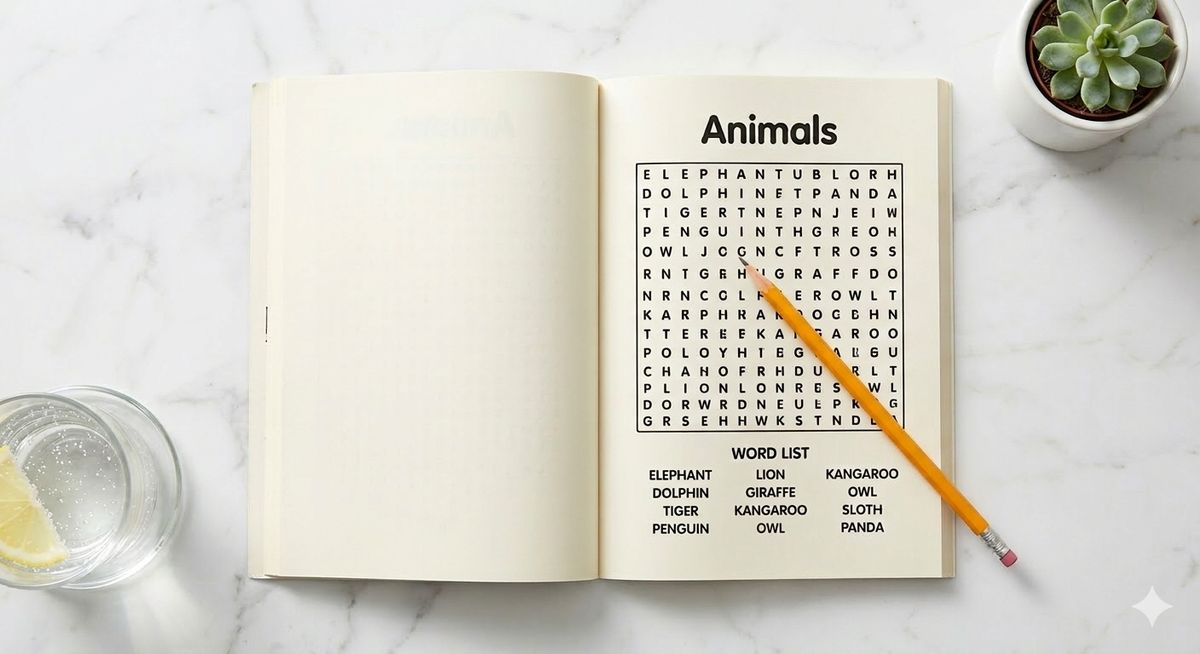
You'd be surprised how many people have never done a word search puzzle. Maybe you've seen them in waiting rooms or on a friend's coffee table but never picked one up. Maybe your doctor suggested puzzles for brain health and you're not sure where to start. Or maybe you used to do them as a kid and want to get back into it but don't know which books are worth buying now.
I publish word search books for a living, and this is the guide I wish existed when readers email me asking "which book should I start with?" Here's everything a beginner needs to know.
How word search puzzles work
A word search gives you two things: a grid of letters and a list of words. Your job is to find each word hidden in the grid and circle it (or draw a line through it). That's it — there are no clues to solve, no math, no trick questions.
Words can be hidden in several directions depending on the puzzle's difficulty. In the easiest puzzles, words only run forward (left to right) and downward. In standard puzzles, words can also run backward and diagonally. In harder puzzles, words go in all eight directions — forward, backward, up, down, and all four diagonals.
When you find a word, cross it off the word list and circle it in the grid. Once all words are found, the puzzle is complete. Some puzzles include a bonus: the leftover letters (the ones not part of any word) spell out a hidden message when read in order.
What to look for in your first book
Not all word search books are created equal, and choosing the wrong one as a beginner can be frustrating. Here's what matters.
Page size. Get a full-size book — 8.5×11 inches, the same as a sheet of printer paper. Pocket-sized books have smaller grids with smaller letters, which strains your eyes. A full-size page gives you room to scan comfortably and circle words without cramping your hand.
Grid size. For beginners, a 15×15 or 18×18 grid is ideal. These are large enough to contain interesting word lists (20-30 words) without being overwhelming. Avoid jumping straight to 20×20 grids with 40 words per puzzle — those are designed for experienced solvers.
Themed word lists. Books with themed puzzles (each puzzle built around a topic like "Kitchen Items" or "Classic Movies") are more enjoyable than books with random words. When you're scanning for "COLANDER" in a kitchen-themed puzzle, your brain is engaging with the meaning of the word, not just its letter pattern. This makes solving feel purposeful rather than mechanical.
Solutions included. This sounds obvious, but some budget puzzle books ship without full solutions. Always check that the book includes answer keys — ideally visual solutions that show the words circled on the grid, not just text lists.
Appropriate difficulty labeling. If the cover says "challenging," "expert," or "extreme," put it down. Look for "easy," "relaxing," or simply no difficulty claim at all. Most standard word search books are perfectly suitable for beginners.
Beginner strategies that work
You don't need a strategy to enjoy word search puzzles, but a few techniques make the process smoother — especially early on.
Scan for the first letter. Pick a word from the list, note its first letter, and scan the grid systematically for that letter. When you find it, check if the surrounding letters continue the word in any direction. This is faster than trying to see whole words at once.
Look for uncommon letters first. If your word list includes a word with Q, X, Z, or J, start with that word. These letters appear less frequently in the filler text, so they're easier to spot in the grid.
Work the short words last. Three-letter words like "THE" or "AND" are harder to find because short letter sequences appear everywhere by coincidence. Save them for the end when fewer unused letters remain and the grid is easier to read.
Use a finger or pen tip as a guide. Track your scanning position with your finger so you don't accidentally skip rows or rescan areas you've already checked. This is especially helpful on larger grids.
Don't force it. If you've been looking for one word for more than a minute, move on to a different word. Fresh eyes often spot what focused searching misses. Come back to the stubborn word after finding a few others.
Which books I recommend for beginners
For absolute first-timers who want themed puzzles:
Hazel Woods — 4000 Big Word Search (100 Themed Puzzles) — $9.99. Full 8.5×11 pages with 20×20 grids. Each puzzle has a clear theme with curated words. The grids are larger than typical beginner books, but the word lists are recognizable and the directions are standard (all eight directions). If you've never done a word search and want something that will last you months, this is a solid starting point. Browse on Amazon →
For beginners who want easier puzzles:
Rockridge Press — Extra Large-Print Easy Word Search for Seniors — ~$8. Don't let "for Seniors" in the title put you off — this is genuinely the easiest well-made word search book I've found. The grids are simplified, the print is extra-large, and the word lists use common vocabulary. It also includes trivia and jokes between puzzles, which breaks up the solving nicely. Available at Target and Barnes & Noble.
For beginners who want maximum variety:
Hazel Woods — 3 in 1 Collection: Easy, Medium & Hard — $9.99. Three difficulty levels in one book. Start with the easy section to build confidence, then progress to medium and eventually hard. This way you don't need to buy three separate books to find your comfort level. Browse on Amazon →
For beginners who want digital (Kindle Scribe):
If you own a Kindle Scribe, the Hazel Woods Kindle Scribe editions let you write directly on the puzzle with your stylus. The hyperlinked navigation makes jumping between puzzles, the index, and solutions effortless. It's a different experience from paper — some people prefer it. Each volume is $2.99, which makes it a low-risk way to try word search puzzles. Browse on Amazon →
How to build a puzzle habit
Research from the University of Exeter and King's College London shows that the cognitive benefits of puzzles increase with frequency — daily puzzlers showed the strongest results. But you don't need to commit to an hour a day. Even one puzzle per day (10-15 minutes) is enough to build a habit and start noticing the benefits.
Keep your puzzle book somewhere visible — on your nightstand, next to your coffee maker, or in your bag. The easier it is to reach for, the more likely you'll pick it up instead of your phone.
If you solve before bed, it works as a screen-free wind-down routine. If you solve in the morning, it sharpens your focus for the day ahead. There's no wrong time — the right time is whenever you'll actually do it consistently.
Frequently asked questions
Are word search puzzles easy to learn? Yes. The rules are simple: find the listed words hidden in a grid of letters. No specialized knowledge, no math, no trick clues. Most people can start solving immediately with no prior experience.
What's the best grid size for beginners? A 15×15 or 18×18 grid strikes the right balance — large enough to hold an interesting number of words but not so large that finding them feels overwhelming. As you improve, you can move to 20×20 grids for a bigger challenge.
How long does it take to solve a word search puzzle? For a standard 15×15 grid with 20 words, most beginners take 10-15 minutes. A 20×20 grid with 30-40 words can take 20-30 minutes. Speed improves naturally with practice — experienced solvers often complete the same puzzles in half the time.
Should I use a pen or pencil? Either works. Pencil lets you erase mistakes, which some beginners prefer. Pen provides more contrast against the printed letters, making circled words easier to see. If you use a pen, choose one that doesn't bleed through the page — fine-tip ballpoints work best.
Can word search puzzles actually help my brain? Yes. Research involving over 19,000 adults aged 50+ found that regular puzzle users performed significantly better on tests of memory, attention, and reasoning. Word searches specifically train visual scanning, pattern recognition, and sustained focus. Read more about the research behind puzzle brain benefits.
Enjoy puzzles? Get 80 free ones.
Join the Hazel Woods email list for free printable word search puzzles, new book announcements, and exclusive giveaways.
Claim Free Puzzles