Why Doctors Recommend Puzzle Books for Seniors
If you've ever had a doctor tell you — or a parent — to "keep the mind active," there's a good chance puzzles came up in that conversation. It's one of the most common pieces of non-pharmaceutical advice neurologists and geriatricians give to older adults. But is there real evidence behind it, or is it just well-meaning encouragement?
I've been creating puzzle books for adults and seniors for years now, and I've read through the research carefully. The answer is more encouraging — and more nuanced — than most people realize.
The Medical Case for Puzzles
There are several reasons healthcare providers keep recommending puzzles, and they're grounded in real evidence.
No Risk, Real Potential Benefit
The most straightforward reason is the risk-benefit calculation. Unlike medications for cognitive decline — which can have side effects and limited efficacy — puzzle books carry essentially zero risk. As the Alzheimer's Drug Discovery Foundation noted in their review of the evidence, there are no health risks associated with puzzle use.
When a patient asks "what can I do to protect my brain?", doctors need suggestions that are evidence-informed, accessible, affordable, and safe. Puzzle books check all four boxes.
The ACTIVE Trial: Long-Term Evidence
One of the strongest pieces of evidence comes from the ACTIVE trial (Advanced Cognitive Training for Independent and Vital Elderly), published in JAMA. Researchers followed 2,802 older adults for over a decade and found that cognitive training — including reasoning and speed-of-processing exercises — produced lasting improvements in cognitive function (Willis et al., 2006).
A later analysis of the ACTIVE data found that participants who received speed-of-processing training had a 29% lower incidence of dementia at the ten-year follow-up compared to the control group. That's a significant reduction from a relatively modest intervention.
The PROTECT Study: Frequency Matters
The PROTECT study tracked over 19,000 adults aged 50–93 and found that word and number puzzle users showed significantly better cognitive function than non-users across every domain measured. The effect was dose-dependent — people who puzzled more frequently scored higher, with the strongest attention scores appearing in those who puzzled more than once daily.
This frequency finding is one reason many doctors recommend daily or near-daily puzzle activity, rather than occasional use. It's not about solving one puzzle a month — it's about building a consistent habit.
In Occupational Therapy and Rehabilitation
Beyond prevention, puzzles play a practical role in occupational therapy. Therapists use word searches, crosswords, and jigsaw puzzles as rehabilitation tools for stroke recovery, traumatic brain injury, and early dementia management. A puzzle provides controlled challenge that exercises planning, sequencing, visual processing, and fine motor skills — and it feels like recreation rather than therapy.
The key insight from rehabilitation settings is that the activity needs to be appropriately difficult. Not so easy it's boring, not so hard it's frustrating.
What Specific Benefits Does the Research Support?
Memory and Recall
The Bronx Aging Study found that crossword puzzle participation delayed the onset of accelerated memory decline by 2.54 years in people who eventually developed dementia (Pillai et al., 2011). Word puzzle use specifically strengthens vocabulary recall and semantic memory — the kind of memory that helps you retrieve the right word in conversation.
Attention and Focus
The PROTECT study data showed the strongest effects on attention measures. Word search puzzles are particularly good for sustained attention — they require you to systematically scan a grid while holding a target word in working memory, which exercises the exact attentional networks that tend to weaken with age.
Stress Reduction
This benefit gets less attention than the cognitive ones, but it may be equally important. Puzzle solving creates a state of focused calm that's similar in some ways to mindfulness. When you're searching for words in a grid, your mind isn't ruminating on worries — it's fully engaged in the present task. For seniors dealing with anxiety, that mental respite has genuine value.
Our Anxiety Relief Word Search was designed with this in mind — 120 puzzles with themes and difficulty calibrated for relaxation rather than frustration.
Social Connection
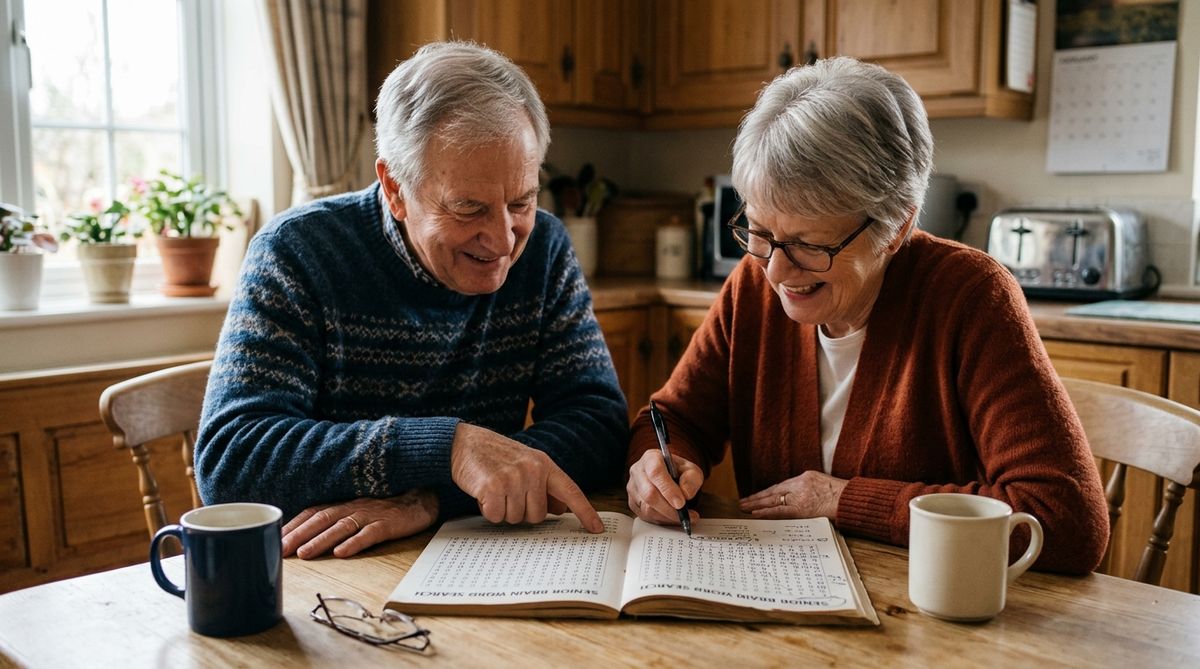
Puzzles can be a solitary activity or a shared one, and the social dimension adds real benefit. Research consistently shows that cognitively stimulating activities done with others — games, puzzles, conversation — provide benefit partly through social engagement itself. Sharing a puzzle book with a grandchild, working through puzzles with a spouse, or joining a puzzle group at a senior center creates meaningful interaction that independently supports brain health.
I hear from readers about this all the time — a daughter who does a puzzle with her mom every Sunday afternoon, or a couple who each solve the same puzzle and compare times over breakfast. The puzzle itself becomes a reason to connect, and that connection matters as much as the cognitive exercise.
Choosing the Right Puzzle Book for a Senior
Not all puzzle books work well for older adults. Here's what I'd look for.
Font size matters enormously. Standard-size puzzle grids cause eye strain quickly. Look for large print or extra-large print editions — this makes a bigger difference than most people expect. I wrote about the best options in our word search books for seniors article.
Themes drive consistency. A puzzle book about topics the person actually cares about — classic movies, travel, nature, history — will get used far more than a generic one. Since the research is clear that frequency matters, anything that encourages daily use is worth prioritizing. Our Baby Boomer Word Search with nostalgic themes is one of the most popular choices among older solvers for exactly this reason.
Appropriate difficulty prevents frustration. Books designed for general adults may use 17×17 or 20×20 grids with 25+ words per puzzle. For seniors, 12×12 or 15×15 grids with 15–20 words offer a satisfying challenge without overwhelm.
Solutions must be included. This sounds obvious, but some popular puzzle books on Amazon don't include solutions — which means you can never check your answers or know if you've truly finished. I'd always choose a book with solutions in the back.
Physical format helps. Spiral-bound or flat-lay books are easier for anyone with limited hand strength. If holding a book open is difficult, a Kindle Scribe is worth considering — the device lies flat, the text is adjustable, and the stylus requires minimal grip strength.
What a Good Puzzle Routine Looks Like
If you're helping a parent or grandparent get started with puzzles, here's what I'd suggest based on the research.
Start with one puzzle a day, ideally at the same time — maybe after breakfast or during the afternoon. Consistency helps build the habit. Keep the book somewhere visible, not tucked in a drawer.
Begin with easier puzzles (12×12 grids, 15 words or fewer) and only move up in difficulty when the current level feels comfortable but not boring. The goal is a satisfying challenge, not a test.
If possible, make it social. Sit with them while they solve. Ask about the theme. Celebrate when they finish one. The social component is genuinely part of what makes this beneficial — it's not just the puzzle, it's the connection around it.
And don't worry about speed. There's no research suggesting that solving quickly is better than solving slowly. What matters is regular engagement over time.
Frequently Asked Questions
Q: Do doctors actually prescribe puzzle books? A: Doctors don't typically "prescribe" puzzle books the way they prescribe medication, but many neurologists and geriatricians actively recommend them as part of a brain-healthy lifestyle. The recommendation is supported by studies like the ACTIVE trial and the PROTECT study, which show measurable cognitive benefits from regular puzzle engagement.
Q: How often should seniors do puzzles for brain health? A: Texas A&M researchers recommend cognitively stimulating activities at least three to four times per week. The PROTECT study found a dose-dependent effect — more frequent puzzling correlated with better scores. A daily 15–20 minute session is a reasonable and achievable goal.
Q: Are word searches good for seniors with dementia? A: They can be, provided the difficulty is appropriate. Large print books with simpler grids (10×10 or 12×12) and familiar themes work best. The activity provides cognitive stimulation, a sense of accomplishment, and a calming focus — all valuable for someone managing cognitive decline.
Q: What's the best type of puzzle for brain health? A: Research suggests mixing different types provides the broadest cognitive workout. Word puzzles strengthen verbal reasoning, number puzzles like sudoku enhance executive function, and jigsaw puzzles exercise visual-spatial skills. Our cognitive benefits article covers this in more detail.
Q: Can puzzles replace medication for cognitive decline? A: No. Puzzles complement medical treatment — they don't replace it. If you or a loved one is experiencing cognitive decline, consult a healthcare provider. Puzzles are best understood as one part of a broader strategy alongside proper medical care, exercise, social engagement, and nutrition.
Enjoy puzzles? Get 80 free ones.
Join the Hazel Woods email list for free printable word search puzzles, new book announcements, and exclusive giveaways.
Enjoy puzzles? Get 80 free ones.
Join the Hazel Woods email list for free printable word search puzzles, new book announcements, and exclusive giveaways.
Claim Free Puzzles