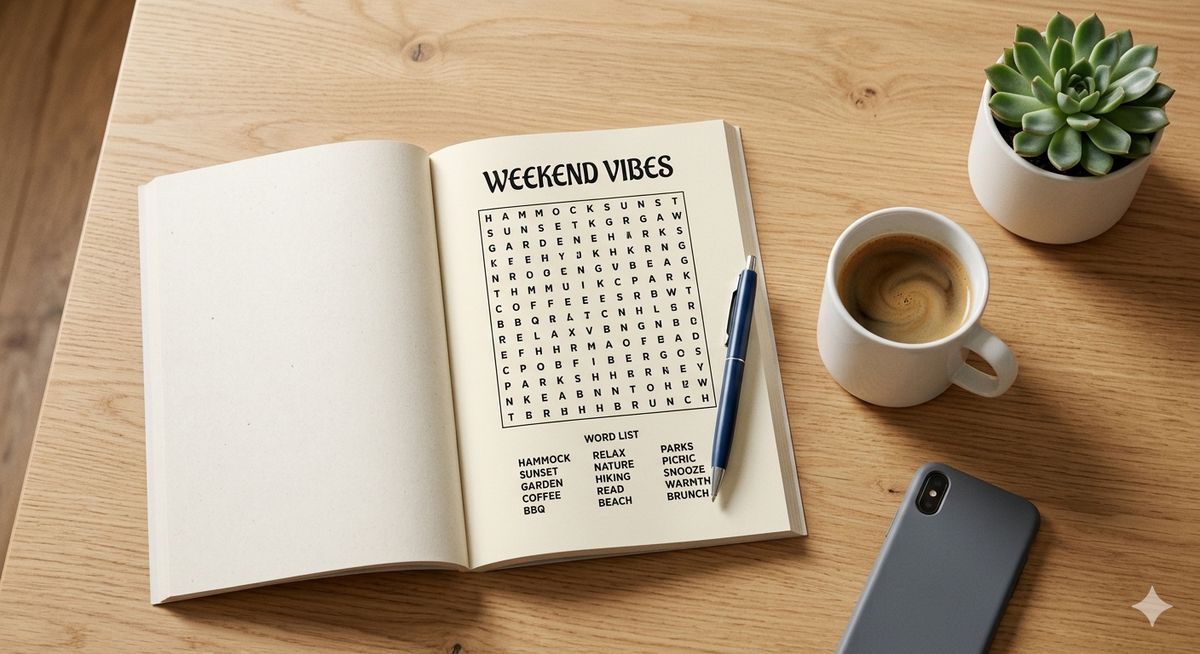
Something interesting is happening in 2026: adults are buying puzzle books at rates not seen in decades. Not apps. Not digital brain training subscriptions. Physical, paper puzzle books — the kind you solve with a pen in your hand and no screen in sight.
This isn't nostalgia. It's a response to something most of us feel but struggle to articulate: we're tired of screens, and we're looking for activities that engage our brains without draining our attention.
The numbers behind the trend
The global games and puzzles market was valued at $22.49 billion in 2025, according to Grand View Research. The puzzles segment specifically is projected to grow at 22.4% annually through 2033 — driven largely by what the report calls "screen-free cognitive engagement, mindfulness-driven leisure, and home-based entertainment routines."
That's market research language for a simple truth: people want something to do with their hands and their minds that doesn't involve a screen.
Insider Intelligence estimates Americans now spend over seven hours a day with digital media. Pew Research Center reports that 54% of teens say giving up social media would be hard, and adults aren't far behind. The backlash is showing up in consumer behavior — puzzle books, coloring books, journaling, and other analog activities are surging as screen counterweights.
NBC Select published a curated guide to the best puzzle books for adults in late 2025, noting that puzzle books are "a great way to entertain and challenge yourself without relying on an app or a screen." The fact that a major news outlet is covering puzzle books as a lifestyle recommendation — not just a holiday gift idea — signals how mainstream this shift has become.
The "analog bag" movement
One of the most visible expressions of this trend is the "analog bag" — a term coined by content creator Sierra Campbell, who went viral on TikTok in 2026 for carrying a tote bag filled with knitting needles, puzzle books, and playing cards instead of reaching for her phone during downtime.
The concept resonated. The National reported on the trend in March 2026, describing how adults are packing puzzle books, crosswords, Sudoku, and card games as alternatives to scrolling during commutes, waiting rooms, and quiet evenings. The article noted that these analog activities provide "mindful focus, social connection and accessible time-fillers during daily waits."
This matters for puzzle book publishers because it's expanding the audience. Puzzle books used to be primarily associated with seniors and children. Now adults in their 30s, 40s, and 50s are picking them up as a deliberate lifestyle choice — the same way earlier generations adopted meditation apps or adult coloring books.
Why puzzle books specifically
Among analog activities, puzzle books have a distinct advantage: they're self-contained, portable, endlessly variable, and they provide a clear sense of progress. You start a puzzle, you finish it, you feel accomplished. There's no algorithm, no infinite scroll, no engagement metric trying to keep you hooked longer than you intended.
Word search puzzles in particular have seen a resurgence because they offer an accessible entry point. You don't need to learn rules, develop specialized knowledge, or tolerate frustration. You scan a grid, you find words, you circle them. The satisfaction is immediate and repeatable.
The cognitive benefits are a bonus. Research from the University of Exeter and King's College London found that regular puzzle users aged 50+ had brain function equivalent to people ten years younger on memory tests. But for many adults buying puzzle books in 2026, the primary motivation isn't brain health — it's the simple pleasure of a focused, screen-free activity that feels like a small act of self-care.
The screen fatigue factor
The COVID-19 pandemic permanently changed how people relate to screens. Remote work, Zoom calls, streaming, and social media meant that by 2021-2022, many adults were spending virtually every waking hour looking at a screen. Even as in-person life returned, the habits stayed — and the fatigue accumulated.
A trauma therapist quoted by Fortune magazine described puzzling as beneficial for people with depression, anxiety, and stress because it provides mental occupation without excessive challenge. The key insight: puzzles offer what screens can't — a bounded, finite experience with a clear endpoint. You finish a puzzle and you're done. There's no notification pulling you back, no next-episode autoplay, no feed to scroll.
For adults managing work stress, information overload, or simply looking for a calmer evening routine, a puzzle book provides something smartphones can't: a genuine off switch.
What this means for puzzle book buyers
If you're new to puzzle books, you're entering a market with more options than ever. Here's what to know.
The quality gap has widened. The surge in demand has brought a flood of low-effort puzzle books to Amazon — auto-generated content with random word lists, tiny grids, and misleading "large print" claims. The best books are published by people who care about puzzle quality: curated themed word lists, readable grid sizes (18×18 or larger), full solutions, and good paper stock.
Themed books outperform generic ones. Puzzle books themed around specific interests — nostalgia, nature, holidays, mindfulness, history — sell better and review better because they transform solving from a mechanical task into an experience. You're not just finding words; you're exploring a topic.
Physical format matters. The analog appeal is part of the draw. People specifically want pen-on-paper, not screen-on-glass. Books with good paper weight, comfortable page sizes (8.5×11), and clean layouts are worth paying a dollar or two more for.
What I'm seeing as a publisher
I started publishing word search books before this trend accelerated, so I've watched the shift happen in real time. Three years ago, puzzle books were a niche market dominated by a few established publishers like Publications International and Kappa Books. The audience was primarily seniors.
Today, the fastest-growing segment of puzzle book buyers is adults aged 35-55 who are discovering (or rediscovering) puzzles as a deliberate screen-free activity. The books they buy tend to be themed, visually appealing, and designed for longer solving sessions — not the thin, pocket-sized volumes of the past.
The other change is digital. Kindle Scribe puzzle books barely existed two years ago. Now they're among the bestselling word search titles on Amazon, driven by adults who want the puzzle experience on a device they already own — but with a stylus and e-ink screen, not a phone. It's an interesting middle ground: digital delivery, analog solving experience.
If you're curious about what a well-made puzzle book looks like, browse the Hazel Woods collection — every book is themed, large print, and designed for adults who want quality over quantity.
Frequently asked questions
Why are puzzle books popular again? The main drivers in 2026 are screen fatigue, growing interest in analog and mindfulness activities, and increased awareness of the cognitive benefits of puzzles. The global puzzles market is projected to grow at 22.4% annually through 2033, reflecting sustained and growing demand.
Are puzzle books better than phone apps for brain health? Research hasn't directly compared puzzle books to apps in a controlled study. However, puzzle books eliminate the downsides of screen-based activity — blue light exposure, notification interruptions, and passive scrolling. The tactile pen-on-paper experience also provides a calming effect that screens don't replicate.
What kind of puzzle book should a beginner start with? Word search puzzles are the most accessible entry point — no specialized knowledge needed, and the satisfaction is immediate. Look for a themed word search book with an 8.5×11 page size and at least 100 puzzles. Themed puzzles are more engaging than random-word puzzles because they give each solve a context.
Is this trend just a fad? Market data suggests otherwise. The puzzle segment's projected 22.4% annual growth rate through 2033 indicates sustained demand, not a short-lived spike. The underlying drivers — screen fatigue and desire for mindful activities — show no signs of reversing.
Enjoy puzzles? Get 80 free ones.
Join the Hazel Woods email list for free printable word search puzzles, new book announcements, and exclusive giveaways.
Claim Free Puzzles