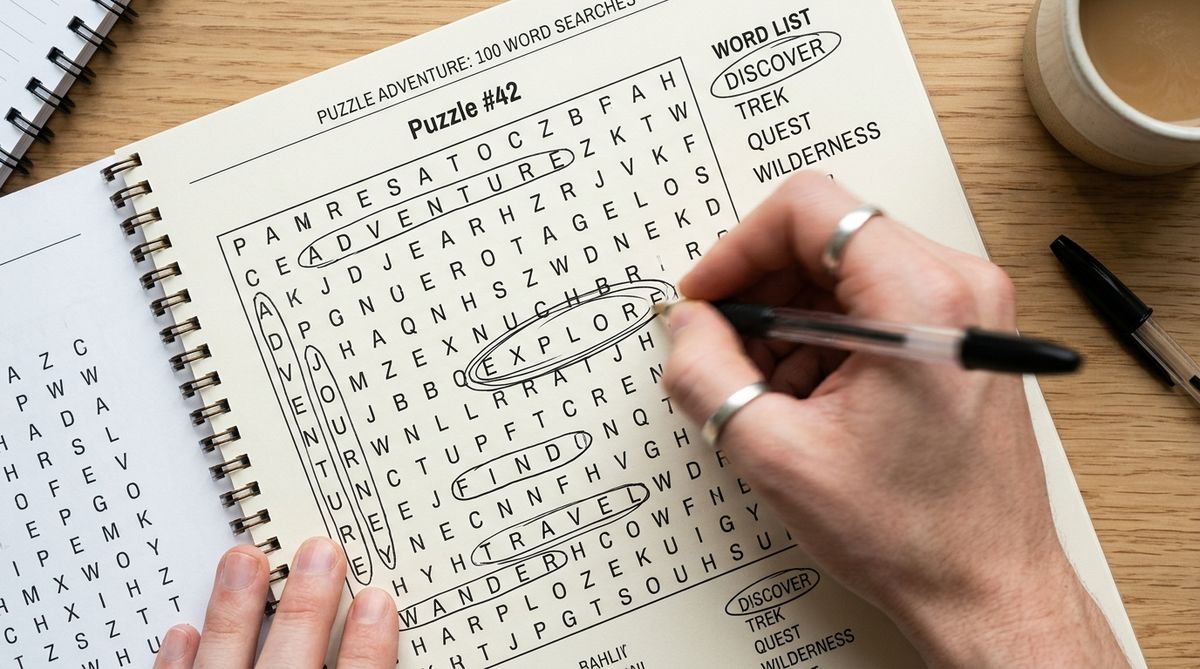
How to Solve Word Search Puzzles Faster: 9 Proven Strategies
There's a moment in every word search puzzle where you've found seven words quickly — and then you spend more time hunting for the last three than you did on the first seven combined. If that sounds familiar, you're in good company. I've designed hundreds of puzzles across 30+ books, and even I get stuck sometimes. The difference between a fast solver and a slow one usually isn't about intelligence — it's about technique.
Here are nine strategies that genuinely work, based on how puzzles are actually constructed.
1. Scan for Uncommon Letters First
This is the single most effective speed technique I know. Instead of reading the word list and then hunting through the grid letter by letter, flip the approach: look at the word list, find the word with the most unusual letters, and scan the grid for those letters.
Letters like Q, Z, X, J, and K appear far less frequently in grids than E, A, S, or T. If you're looking for QUARTZ, scan for Q — there might only be two or three Q's in the entire grid. Once you spot one, check if U-A-R-T-Z follows in any direction. You'll find it in seconds rather than minutes.
2. Work the Diagonals Early
Most people naturally scan horizontally and vertically because that's how we read. Puzzle designers know this — which is why diagonal placements tend to be the ones that stump solvers longest.
Train yourself to check diagonals actively. When you spot the first letter of a word, check all eight directions: right, left, down, up, and the four diagonals. Building this habit eliminates the frustrating experience of staring at a grid when the word was sitting on a diagonal the whole time. For more foundational techniques, see our full guide to solving word search puzzles.
3. Use the Grid Borders
Words that start or end at the edge of the grid are constrained — they can only extend inward. Border letters have fewer possible directions to check (three to five instead of eight). Scanning the top row, bottom row, left column, and right column first can knock out several words quickly.
4. Look for Double Letters
Words with double letters — COFFEE, BOOKKEEPER, LLAMA — are easier to spot than you'd think. Your eye naturally catches letter pairs that stand out from the random fill. Scan the grid for pairs like FF, OO, LL, or EE — they often belong to a word on your list.
5. Cross Off Words Immediately
This sounds obvious, but a lot of solvers don't do it consistently. The moment you find a word, cross it off the list and circle it in the grid. This reduces your mental load (fewer words to hold in memory) and makes it easier to see which words remain — sometimes revealing patterns like "all three remaining words contain the letter K."
6. Read Backwards
Reversed words (right-to-left or bottom-to-top) catch most solvers off guard. Practice reading your word list backwards: if you're looking for GARDEN, also be scanning for NEDRAG. Some experienced solvers read the grid itself from right to left across each row — this surfaces reversed horizontal words your left-to-right scan would miss.
7. Break the Grid Into Quadrants
For large grids (15×15 or bigger), scanning the whole thing for one word gets exhausting for your eyes. Mentally divide the grid into four sections and search each one systematically: top-left, top-right, bottom-left, bottom-right. This prevents the "I've been staring at this for five minutes and everything's blurring together" problem.
This technique is especially helpful with our 4000 Big Word Search, which uses larger grids with 40 words per puzzle. Quadrant scanning keeps your focus sharp even on the most packed grids.
8. Save Short Words for Last
This one is counterintuitive, but three- and four-letter words like CAT, TREE, or MOON are actually harder to find than longer ones. Their letters are so common that they appear in dozens of random combinations throughout the grid. Long words like INDEPENDENCE or CONSTELLATION have unusual letter sequences that stand out.
Start with the longest words on your list and work down. By the time you get to the short words, you'll have already circled several long ones, and those circled letters will help guide your eye.
9. Use Found Words as Landmarks
Every word you find creates a reference point in the grid. If you know BUTTERFLY runs diagonally through the center, and you're looking for FLOWER, and both share the letter L, check whether FLOWER intersects or runs nearby. Puzzle designers frequently cross words through shared letters, so found words often point right to unfound ones.
Putting It All Together
The fastest solvers combine several of these techniques naturally. An efficient approach looks something like: start with the longest and most unusual words, check borders and diagonals, use uncommon letters as anchors, and save the short common words for last.
Here's what this looks like in practice. Say you're solving a puzzle with the theme "Cozy Knitwear" and the word list includes CASHMERE, YARN, SCARF, and WOOL. You'd start with CASHMERE — it's the longest word and has an uncommon letter combination. Scan the grid for C's, and when you find one, check all eight directions for A-S-H-M-E-R-E. Found it? Circle it and cross it off. Now try SCARF (the SC combination is distinctive). Save YARN and WOOL for last — they're short and their letters are everywhere in the grid.
That approach will consistently get you through puzzles faster than reading the grid left-to-right looking for each word in order.
If you want to practice across different difficulty levels, our 3-in-1 Easy/Medium/Hard Collection has 120 puzzles graded across three levels. Start with the easy section to build your scanning speed, then move up to hard where these techniques really pay off.
You can also try a free interactive word search on our website — the timer feature lets you track your improvement over time.
Why Getting Faster Actually Matters
Beyond the satisfaction, there's a practical brain health reason to get more efficient. The University of Exeter's PROTECT study found that frequent puzzle solvers showed better cognitive function across attention, reasoning, and memory. The key word is "frequent" — if a puzzle takes 45 minutes and feels frustrating, you're less likely to come back tomorrow. If it takes 10 minutes and feels like a satisfying win, you'll do one every day.
This idea isn't unique to me — puzzle strategy guides across the board recommend building speed through technique rather than rushing. The common thread is that scanning strategies and pattern recognition do more for your solve time than just trying harder.
Getting faster isn't about rushing. It's about solving more efficiently, which means solving more often — and that's where the real benefit lives. I've had readers tell me they went from doing one or two puzzles a week to doing one every morning with their coffee, simply because the puzzles stopped feeling like a chore once they had a system. That daily habit is worth far more than any individual fast solve.
Frequently Asked Questions
Q: What's the fastest way to find hidden words in a word search? A: Start with the longest words and those containing uncommon letters like Q, Z, X, J, or K. Scan for those rare letters in the grid first — they'll have very few occurrences, making the word easy to trace. Check diagonals early, since they're the most commonly missed direction.
Q: Why can't I find the last word in a word search puzzle? A: Almost always, it's hiding in a direction you haven't checked — usually diagonal or reversed. Systematically check all eight directions from each occurrence of the word's first letter. Also scan the grid borders, which are easy to overlook.
Q: How long should a word search puzzle take? A: For a standard 15×15 grid with 20–25 words, experienced solvers typically finish in 5–15 minutes. Beginners might take 20–30 minutes. There's no "right" speed — the goal is enjoyment and engagement. That said, these techniques can easily cut your solve time in half.
Q: Do word search puzzles get easier with practice? A: Absolutely. Your brain develops pattern recognition the more you solve. Regular solvers report that words start "jumping out" of the grid without conscious searching — that's your visual processing system getting trained. Most people notice real improvement within two to three weeks of daily practice.
Q: Are harder puzzles better for your brain? A: Puzzles that challenge you without frustrating you are the sweet spot. If it's too easy, your brain isn't working hard enough. If it's too hard, you'll give up. The ideal is finding most words fairly quickly but having to work for the last few — then gradually increasing difficulty over time.
Enjoy puzzles? Get 80 free ones.
Join the Hazel Woods email list for free printable word search puzzles, new book announcements, and exclusive giveaways.
Enjoy puzzles? Get 80 free ones.
Join the Hazel Woods email list for free printable word search puzzles, new book announcements, and exclusive giveaways.
Claim Free Puzzles