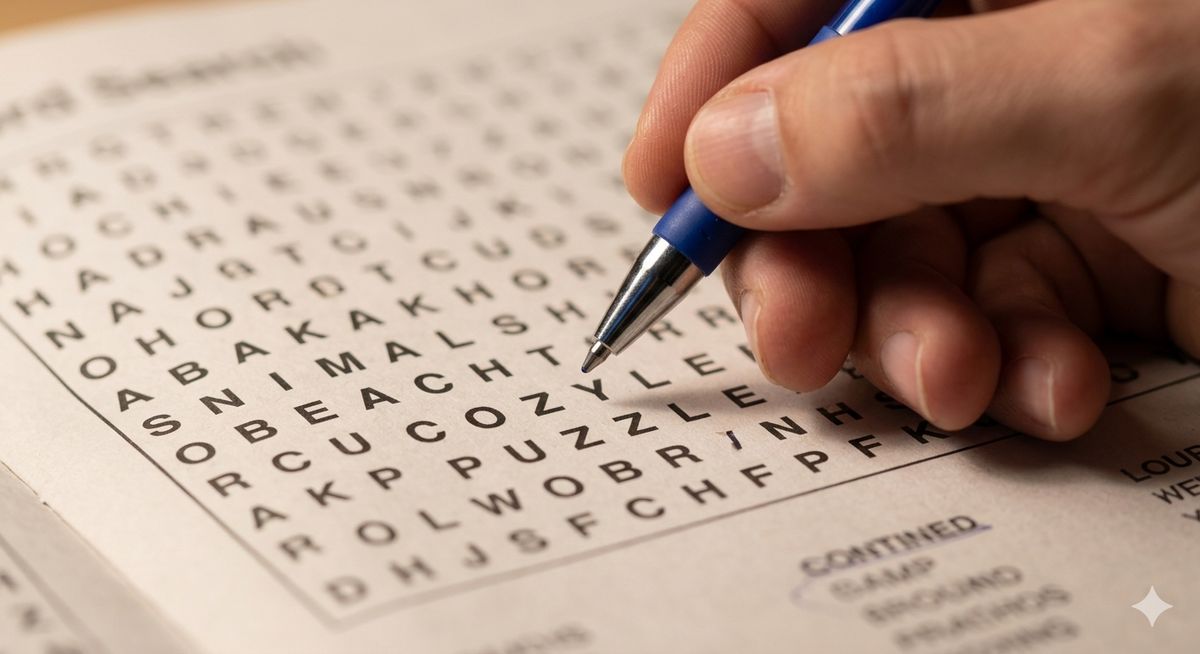
Whether you're picking up your first word search book or you've been solving for years, there are techniques that make finding hidden words faster, more systematic, and more satisfying. I've published over 40 word search books and designed thousands of puzzles, which gives me an unusual perspective — I know where words hide because I'm the one hiding them.
This guide covers everything from basic rules to advanced speed-solving techniques. Bookmark it and come back when you need a refresher.
The basics: how word search puzzles work
A word search puzzle consists of a grid of letters (typically 15×15 to 20×20) and a list of words hidden within that grid. Your task is to find each word and mark it — usually by circling it or drawing a line through it.
Words can be hidden in up to eight directions: horizontally (left to right and right to left), vertically (top to bottom and bottom to top), and diagonally (in all four diagonal directions). Not all puzzles use all eight directions — easier puzzles restrict words to forward and downward only, while harder puzzles allow all directions including backward and diagonal.
When you find a word, mark it in the grid and cross it off the word list. Once all words are found, the puzzle is complete. In some puzzles, the remaining unused letters spell out a bonus hidden message when read left to right, top to bottom.
Beginner strategies
If you're new to word search, these foundational techniques will get you solving comfortably.
Scan for the first letter
Pick a word from your list, note its first letter, and scan the grid row by row looking for that letter. When you find it, check the surrounding letters in all valid directions to see if the word continues. This is more efficient than trying to spot complete words at a glance — your brain processes single-letter matches faster than multi-letter patterns.
Start with the longest words
Longer words are paradoxically easier to find than short ones. A seven-letter word takes up significant space in the grid and has a distinctive letter sequence. A three-letter word like "CAT" might appear multiple times by coincidence within the filler letters, leading you down false paths. Start with the longest words on your list and work your way down to the shortest.
Look for uncommon letters
Letters like Q, X, Z, J, and K appear rarely in the random filler letters that pad the grid. If one of your target words contains these letters, scan the grid specifically for them. Finding a Z in the grid almost certainly means it belongs to one of your target words, giving you a strong anchor point.
Use a finger or pointer
Run your finger along each row as you scan. This prevents your eyes from skipping rows or accidentally rescanning areas you've already checked. It sounds simple, but it dramatically reduces wasted scanning time — especially on larger grids where your eyes can drift.
Cross off found words immediately
As soon as you find and circle a word, cross it off the list. This serves two purposes: you won't waste time looking for a word you've already found, and the shrinking list gives you a sense of progress that keeps you motivated.
Intermediate strategies
Once you're comfortable with the basics, these techniques will improve your speed and accuracy.
Scan by row, then column, then diagonal
Work through the grid systematically rather than jumping around. First, scan every horizontal row from left to right (this catches forward words and helps you spot backward words too). Then scan every vertical column from top to bottom. Finally, scan the diagonals. This ensures you cover the entire grid without missing any sections.
Look for letter pairs, not single letters
Instead of searching for the first letter of a word, search for the first two letters together. The letter pair "QU" is much rarer in a grid than "Q" alone, so spotting the pair narrows your search dramatically. This works especially well for words with distinctive openings: "TH," "SH," "CH," "WH," or double letters like "LL," "EE," "OO."
Spot common suffixes and prefixes
Many English words end with recognizable patterns: "-ING," "-TION," "-ED," "-LY," "-NESS." If you notice one of these patterns in the grid, trace backward from it to see if it completes a word on your list. Similarly, prefixes like "UN-," "RE-," "PRE-" can serve as starting anchors.
Use the theme as a guide
Themed word search puzzles (where all words relate to a single topic) give you a cognitive advantage. Your brain is primed to recognize words that fit the theme, which means you'll often spot them subconsciously while scanning for other words. Let the theme work for you — read the word list with the theme in mind before starting, and your brain will do some of the searching automatically.
Divide the grid into quadrants
Mentally split the grid into four sections (top-left, top-right, bottom-left, bottom-right) and search one quadrant at a time. This prevents the feeling of being overwhelmed by a large grid and ensures you don't neglect any area. Once you've thoroughly scanned one quadrant, move to the next.
Advanced strategies
For experienced solvers looking to solve faster or tackle harder puzzles.
Turn the book upside down
This sounds odd, but it works. Your brain has strong pattern recognition for words read in the normal orientation. When you flip the book upside down, backward words become forward words, and words you couldn't see before suddenly jump out. Many experienced solvers report that this single trick helps them find their last few stubborn words.
Focus on word endings for backward words
When a puzzle includes backward words, don't try to read them backward — instead, look for the last letter of the word (which appears first in the backward placement) and scan from there. Finding "ELPPA" is hard; finding "E" and then checking if "L-P-P-A" follows forward is much easier than trying to read "APPLE" backward in your head.
Track double letters
Double-letter combinations (LL, EE, OO, SS, TT) stand out visually in a grid of random letters. If one of your target words contains a double letter, scan specifically for that pair. Two identical letters side by side are rare enough in filler text that they almost always belong to a hidden word.
Solve without the word list first
In standard puzzles, try scanning the grid before looking at the word list. Experienced solvers often spot words naturally as their eyes move across the grid — especially in themed puzzles where the vocabulary is predictable. After finding everything you can spot organically, consult the list for the remaining words. This builds your visual pattern recognition skills over time.
Time yourself
Set a timer and track how long each puzzle takes. Not to stress yourself, but to create a feedback loop. You'll notice which strategies shave off time and which puzzle characteristics slow you down. Over weeks of tracking, you'll see genuine improvement in your solving speed.
Choosing the right tools
Pen vs pencil: Pen provides better contrast against printed letters, making circled words easier to see. Pencil allows erasure if you circle a false match. For most solvers, a fine-tip ballpoint pen is the best balance — clear marking without bleeding through the page.
Highlighters: Some solvers prefer highlighting found words instead of circling them. Highlighting is less visually cluttered than circles, which helps on dense grids where found words overlap each other. Yellow or light-orange highlighters work best — they mark clearly without obscuring the underlying letters.
Ruler or straight edge: Placing a ruler below the row you're scanning keeps your eye tracking precise. This is especially helpful on grids larger than 18×18 where rows start to blur together.
Common frustrations and how to handle them
"I can't find the last word." This happens to everyone. Step away for five minutes, then look at the grid with fresh eyes. Try turning the book upside down. Read the word you're looking for out loud — sometimes hearing the letter sequence helps your brain process it differently. If you're truly stuck, check if the word appears backward or diagonally — these are the most commonly missed directions.
"My eyes get tired on large grids." Take breaks every 2-3 puzzles. Use a ruler to isolate individual rows. Make sure you're solving in good lighting — dim light forces your eyes to work harder. If eye fatigue is a recurring issue, switch to an extra-large print book or consider the Kindle Scribe, which has excellent contrast on its e-ink screen.
"I keep finding words that aren't on the list." This is actually a sign of strong visual pattern recognition — your brain is working well. In many puzzles, these "phantom words" are unintentional byproducts of the random filler letters. Mark them if you want (it's satisfying), but focus on the listed words to complete the puzzle.
Practice makes faster
Like any skill, word search solving improves with practice. The neural pathways involved in visual scanning, pattern recognition, and letter sequence matching become more efficient the more you use them. Most regular solvers report noticeable speed improvements within 2-3 weeks of daily practice.
For a structured practice routine, try one puzzle per day for 30 days. Time yourself on day 1 and day 30 using puzzles of the same difficulty and grid size. The improvement will likely surprise you.
If you're looking for well-designed puzzles to practice with, the Hazel Woods collection features themed 20×20 grids that progress naturally from engaging to challenging. Every word list is curated — no random filler words — which makes the solving experience more satisfying as you build your skills.
Frequently asked questions
What's the fastest way to solve a word search? Scan systematically by row, then column, then diagonal. Start with the longest words and those containing uncommon letters (Q, X, Z, J). Use letter pairs instead of single letters as search anchors. These combined techniques can cut your solving time significantly.
Why can't I find the last word in a word search puzzle? The most commonly missed words are backward words, diagonal words, and short words (3-4 letters) that blend into the filler text. Try turning the book upside down, using a ruler to scan each row individually, or stepping away briefly and returning with fresh eyes.
Is there a strategy for backward words? Yes. Instead of trying to read the word backward, find the last letter of the word (which appears first in the backward placement) and trace forward from there. Your brain processes forward reading much faster than backward reading.
How long should a word search puzzle take? For a standard 15×15 grid with 20 words, experienced solvers typically finish in 5-10 minutes. A 20×20 grid with 30-40 words takes 15-25 minutes. Beginners should expect roughly double these times. Speed improves naturally with regular practice.
Do word search puzzles get easier with practice? Yes. Regular solving trains your brain's visual scanning and pattern recognition systems. Most people notice meaningful speed improvement within 2-3 weeks of daily practice. The cognitive skills developed through word search transfer to other visual processing tasks as well.
Enjoy puzzles? Get 80 free ones.
Join the Hazel Woods email list for free printable word search puzzles, new book announcements, and exclusive giveaways.
Claim Free Puzzles