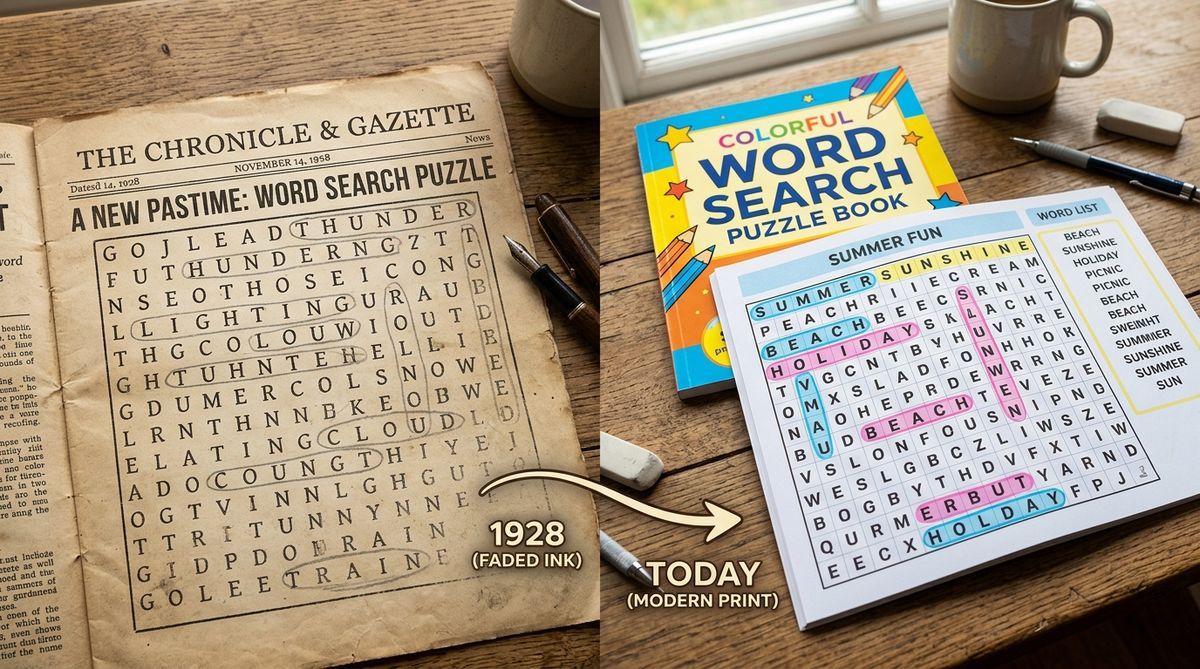
The History of Word Search Puzzles: From 1968 to Today
Word search puzzles feel like they've always existed. You've probably solved them on restaurant placemats as a kid, found them in the back of newspapers, and grabbed puzzle books from the grocery store checkout. But the word search is actually a surprisingly recent invention — younger than most of the people who enjoy solving them. And its origin story involves a small-town Oklahoma publisher, a contested Spanish inventor, and a nationwide spread driven entirely by schoolteachers.
March 1, 1968: The First Word Search
The word search puzzle was created by Norman E. Gibat and first published on March 1, 1968, in the Selenby Digest, a small want-ad publication distributed for free at Safeway and other shops in Norman, Oklahoma. The original page was just 8.5 by 5.5 inches — smaller than most puzzle books today.
Gibat had a simple goal: create something that would set his modest publication apart and give readers something to enjoy while waiting in line at the supermarket. His first puzzle was a 20×20 grid with 34 Oklahoma city names hidden horizontally, vertically, and diagonally. The following week's puzzle used Norman's street names.
The puzzles were an immediate hit locally, but the real boost came from an unexpected audience — teachers. Educators in Norman quickly saw the puzzle's potential as a learning tool and began requesting reprints for their classrooms. One teacher sent copies to colleagues in other states, and the idea spread across the country through an informal network of educators, long before the internet made sharing instant.
Gibat never patented the concept. An unknown individual eventually sent the idea to a syndicator, and by the early 1970s, word search puzzles were appearing in newspapers and magazines nationwide. According to Wikipedia's history of the word search, there's also a possible earlier claim from James Patrick Carr of Villa Grove, Illinois, who may have created similar puzzles before 1968 — though this hasn't been definitively verified.
It's a bit wild to think about. Something we take completely for granted as a puzzle format is less than sixty years old, was never patented, and spread across the country through photocopied handouts from schoolteachers.
The Spanish Connection
Gibat's claim to invention has a notable competitor. Pedro Ocón de Oro, a prolific Spanish puzzle creator credited with inventing over 125 puzzle types, was publishing Sopa de Letras ("Soup of Letters") during the 1960s. The format was essentially identical to Gibat's word search.
Historians haven't pinpointed when exactly Ocón de Oro created his version, which is why Gibat generally receives official credit for the documented 1968 publication date. Whether Gibat was influenced by the Spanish version or invented the concept independently remains an open question.
The name Sopa de Letras persists throughout the Spanish-speaking world today. When I publish Spanish word search books, that's the term we use — the puzzle's identity is so tied to Ocón de Oro's naming that it would feel wrong to call it anything else.
The 1970s and 1980s: Rapid Growth
Once word searches escaped Oklahoma, their growth was fast. By the mid-1970s, the puzzles appeared regularly in newspaper puzzle sections alongside crosswords. CBS even adapted the format for television — Now You See It, a game show that ran in 1974–75 and was briefly revived in 1989, featured a word search grid that contestants raced to solve.
The 1980s brought the puzzle book boom. Dedicated word search books appeared in bookstores, supermarkets, airports, and drug stores. Publishers like Kappa began producing themed collections and introducing variations — including puzzles where the unused letters in the grid spelled out a secret message, which became Kappa's signature format.
Themes drove much of this growth. Rather than random word lists, publishers created puzzles around animals, history, sports, holidays, and pop culture. Themes made each puzzle feel fresh — the same format could be completely different depending on whether the words were about space exploration or favorite desserts.
This is something I think about a lot in my own work. When I create a puzzle themed around, say, "Cozy Knitwear" or "Classic Movies," the word list does more than fill a grid — it sparks memories and associations for the solver. You see CASHMERE in the grid and you think about your favorite sweater. You find CASABLANCA and you hear Humphrey Bogart. That emotional layer is what makes themed puzzles so much more engaging than random word lists, and it's been true since the 1980s publishers figured it out.
Why the Format Never Changed
Here's something I find remarkable: the fundamental format of a word search puzzle in 2026 is identical to Gibat's 1968 original. A grid of letters. A list of hidden words. The challenge of finding them all.
Compare this to crosswords, which have evolved through themed grids, cryptic variants, and complex construction rules. Or sudoku, which has spawned killer sudoku, samurai sudoku, and dozens of variations. Word searches have stayed structurally stable for nearly sixty years.
I think the reason is elegant simplicity. The format requires no instructions beyond a glance. It works for ages 5 to 95. It adapts to any topic, language, or difficulty level. You can make it harder by adding more words, using a larger grid, including diagonals and reversed placements, or removing the word list entirely. But the core experience — scanning, recognizing, finding — stays the same.
This stability is also why word search books continue to sell millions of copies even in the age of smartphones. The experience of pen on paper, circling words in a physical grid, hasn't been fully replaced by screens — though the Kindle Scribe with its stylus comes surprisingly close.
The Digital Era
Online word search games became popular through Facebook and mobile apps in the 2010s. Games like Wordscapes and various word-finding apps brought the format to a new generation of solvers. But digital word searches face a real limitation: tapping a screen isn't as satisfying as circling a word with a pen.
Interactive puzzle books on e-ink devices represent the latest evolution — combining the feel of writing with the convenience of digital navigation. I've published eight volumes for the Kindle Scribe now, and the experience of designing for a stylus-first device taught me a lot about what makes digital puzzles work. The key is hyperlinked navigation — tap a puzzle number to jump to it, tap the solution to check your answer, tap again to go back. That interactivity is something paper will never match.
You can try a free interactive word search on our website to see what modern digital puzzle solving feels like.
What Norman Gibat Started
Gibat created a puzzle to fill space in a small-town digest. Nearly sixty years later, word search puzzle books sell in every corner of the world. The format is used in classrooms, hospitals, retirement communities, and living rooms everywhere.
What strikes me most is how the puzzle book industry built on Gibat's foundation. Today you can find word search books themed around almost anything — holidays, travel, nostalgia, Bible verses, sports, food, and more. The themed approach that publishers developed in the 1980s turned a simple format into something that connects emotionally with solvers. A puzzle about "Classic Sitcoms" or "Cozy Knitwear" isn't just a grid of letters — it's a prompt that brings up personal memories and associations while you solve. That emotional connection is something Norman Gibat's first Oklahoma city puzzle probably didn't anticipate, but it's a big part of why the format endures.
I've published over 30 word search puzzle books and designed thousands of individual puzzles — from nostalgic themes in our Baby Boomer Word Search to seasonal collections and digital Kindle Scribe editions. The format still delights me every time. That's the mark of a genuinely great invention.
Frequently Asked Questions
Q: Who invented the word search puzzle? A: Norman E. Gibat is credited with creating the first English-language word search, published on March 1, 1968, in the Selenby Digest in Norman, Oklahoma. Spanish puzzle creator Pedro Ocón de Oro also developed a similar format called Sopa de Letras during the 1960s, though the exact date of his invention hasn't been confirmed.
Q: What was the first word search puzzle about? A: The first puzzle featured 34 Oklahoma city names hidden in a 20×20 grid. The following week's puzzle used street names from Norman, Oklahoma.
Q: Why are word search puzzles so popular? A: The format is elegantly simple — it requires no instructions, works for all ages and skill levels, adapts to any theme or language, and provides the satisfying experience of visual discovery. The act of circling a found word is uniquely gratifying.
Q: When did word search puzzle books become widely available? A: Word search books became common in bookstores and supermarkets during the 1980s, after spending the 1970s growing through newspaper syndication and classroom use.
Enjoy puzzles? Get 80 free ones.
Join the Hazel Woods email list for free printable word search puzzles, new book announcements, and exclusive giveaways.
Enjoy puzzles? Get 80 free ones.
Join the Hazel Woods email list for free printable word search puzzles, new book announcements, and exclusive giveaways.
Claim Free Puzzles