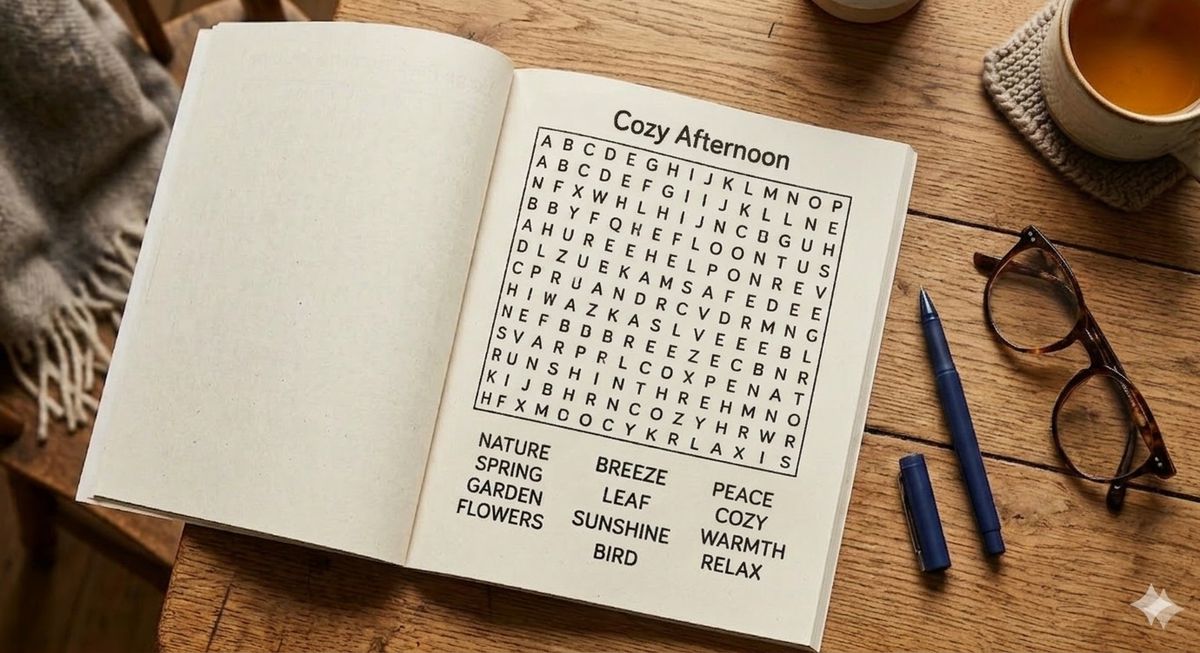
"Large print" is one of the most misleading claims in the puzzle book world. I've bought competitor books labeled "large print" that use 14-point font crammed onto a 5×8 page — technically larger than standard, but still a strain to read. As a publisher of over 30 word search books, I've spent years studying what actually makes a puzzle book comfortable to solve, and print size is only part of the equation.
This guide explains what to look for when shopping for large print word search books, and recommends specific titles across different categories and budgets. I include my own books where they're the best fit, and competitor titles where they genuinely deserve the recommendation.
What "large print" actually means
There's no industry standard for what qualifies as "large print" in puzzle books. Unlike novels, where large print is generally defined as 14-point type or above, puzzle books have no formal threshold. Publishers use the label freely.
What matters for word search readability isn't just font size — it's the combination of three factors: the font size of the grid letters, the page size (trim size) of the book, and the grid size relative to the page.
A 16-point font on an 8.5×11 page feels spacious. The same 16-point font on a 5.5×8 page feels cramped because the grid has to be smaller, the margins tighter, and the word list squeezed into whatever space remains.
Here's the practical rule: look for books with an 8.5×11 trim size (the same size as a sheet of printer paper). This is the format that gives you the largest possible grid with genuinely comfortable letter sizing. Anything smaller is a compromise — it might still be enjoyable, but it won't be as easy on the eyes as a full-size book.
What else affects the solving experience
Beyond print size, several other factors determine whether a word search book is pleasant to use for extended sessions.
Paper weight. Thin paper bleeds through when you circle words with a pen or marker. You end up seeing ghost marks from the puzzle on the other side, which is distracting. Better puzzle books use heavier stock — you can usually tell by the book's weight relative to its page count. Spiral-bound books from publishers like Publications International tend to use thicker paper, as do many KDP-published titles that specify premium paper options.
Grid size. A 12×12 grid gives you maybe 15-20 hidden words. A 20×20 grid can hold 30-40 words per puzzle. Larger grids mean more words per puzzle, longer solving time, and a more satisfying experience. They also mean the individual letters can be printed larger because there's more page real estate to work with.
Word list placement. Some books put the word list below the grid on the same page. Others put it on the facing page. Some put all word lists in a separate section at the back. Below the grid on the same page is the most convenient — you don't have to flip pages or hold your place while scanning.
Solution quality. Good solutions clearly mark each found word on a grid, usually with circles or highlights. Some books only list the coordinates (e.g., "ROW 3, COLUMN 7, DOWN") which is tedious to verify. Look for visual solution grids.
Binding. Spiral-bound books lay flat on a table or in your lap. Perfect-bound (glue spine) books fight you — they want to close, especially early in the book. Spiral is objectively better for puzzle solving, but it's also more expensive to produce, so most budget-friendly puzzle books are perfect-bound. Some publishers compromise with a wide spine and flexible cover, which helps but isn't as good as spiral.
The best large print word search books by category
Best for themed variety
Hazel Woods — 4000 Big Word Search (100 Themed Puzzles) — $9.99
100 puzzles on 20×20 grids, full 8.5×11 pages. Every puzzle is themed around a specific topic with curated word lists — not random dictionary words. What sets this apart from most large print options is the quality of the word lists: the themes range from Classic Hollywood to World Capitals to Cozy Autumn, and every word genuinely belongs. Includes full visual solutions and a QR code for 80 free bonus printable puzzles.
Best for: Solvers who care about what they're finding, not just that they're finding it. Browse on Amazon →
Best value per puzzle
Martin Littlewolf — Big Book of Large Print Word Search Puzzles (Words of Wonder!) — $9.99
224 themed puzzles with 5,000 words. This is the book that set the bar for value in the large print category. The puzzles are themed, the grids are a good size, and the page count is hard to beat at this price point. It's consistently one of the bestselling word search books on Amazon for a reason.
Best for: Anyone who wants maximum puzzle count per dollar. View on Amazon →
Best mega collection
Hazel Woods — 8000+ Unique Words (4 in 1 Collection) — $14.99
201 puzzles across four themed volumes in one book. This is genuinely the best value proposition in the large print category if you factor in both puzzle count and word list quality. Over 8,000 unique words means almost zero repetition across 200+ puzzles — a common problem in high-volume puzzle books where the same words get recycled.
Best for: Gift-giving or anyone who solves daily and doesn't want to buy a new book every month. Browse on Amazon →
Best spiral-bound
Brain Busters — Large Print Word Search Puzzles (Publications International) — $12-15
Over 200 puzzles in a spiral-bound, lay-flat format. Publications International (PIL) is a traditional publisher with retail distribution — you'll find these at Barnes & Noble, Target, and Walmart. The spiral binding is the standout feature. The paper quality is solid, the print is genuinely large, and the themes are varied. The price is higher than most KDP-published books, which reflects the spiral binding and retail markup.
Best for: People who solve at a desk or table and want a book that stays open without holding it. View on Amazon →
Best for seniors with vision challenges
Easy Jumbo Word Search for Seniors — $7-10
Extra-large print specifically designed for older adults. The grids are simplified, the words are common and recognizable, and the layout maximizes readability above everything else. This isn't a challenging puzzle book — it's an accessible one. The word lists use familiar terms rather than obscure vocabulary, which is important for seniors who may find unusual words frustrating rather than fun.
Best for: Seniors with low vision, macular degeneration, or anyone who needs the largest possible print. View on Amazon →
Best for relaxation and mindfulness
Hazel Woods — Anxiety Relief Word Search — $9.99
120 puzzles centered on mindfulness themes — positive affirmations, nature, calm environments, and soothing topics. The word lists are intentionally chosen to reinforce a relaxed state. This isn't just a puzzle book with a calming cover; the content itself is designed to feel peaceful. Full 8.5×11 large print format with 20×20 grids.
Best for: Anyone who uses puzzles specifically for stress relief or as a screen-free calming activity. Browse on Amazon →
Best for Kindle Scribe
Hazel Woods — Large Print Word Search Puzzles Vol. 1-8 (Kindle Scribe) — $2.99 each
If you own a Kindle Scribe, paper large print becomes irrelevant — the digital screen provides perfect contrast and you can write directly on puzzles with the stylus. These volumes are designed specifically for the Kindle Scribe with hyperlinked navigation: tap to jump between the index, puzzles, and solutions. Each volume has 144 puzzles with 3,400 words.
Best for: Kindle Scribe owners. These consistently rank among Amazon's bestselling word search titles. Browse on Amazon →
How to spot a misleading "large print" claim
Before buying any word search book labeled "large print," check three things on the product listing.
First, look at the trim size. If it's smaller than 8×10, the "large print" is relative to a very small page. A 14-point font on a 5×8 page is technically large print, but it won't feel comfortable during a long solving session.
Second, check the preview or "Look Inside" images if available. Can you read the grid letters clearly in the thumbnail? If they're hard to see in the product image, they'll be harder in person.
Third, read the reviews. Phrases like "smaller than expected," "hard to read," or "not really large print" are red flags. Conversely, reviews that say "easy on the eyes" or "my mom loves it" are positive signals — especially from older adults or people buying for seniors.
What about paper quality?
This is something you can't easily judge from a product listing, but it matters more than most people realize. If you plan to solve with a pen (rather than a pencil), thin paper will show bleed-through from ink on the reverse side. This is especially frustrating in large print books because you're already paying a premium for readability — having the previous page's marks show through defeats the purpose.
Most KDP-published books (including mine) use cream or white paper that handles pen ink reasonably well without significant bleed-through. Traditional publishers vary — spiral-bound books from PIL tend to use quality stock, while some budget multi-packs use thinner paper to keep costs down.
If in doubt, start with one book before buying a multi-pack. A single $9.99 book that uses good paper is more satisfying than a 6-pack of thin-paper books you don't enjoy solving.
Frequently asked questions
What font size is considered large print for word search? There's no industry standard for puzzle books specifically. For novels, large print is generally defined as 14-point type or above. For word search puzzles, the combination of font size and page size matters most. An 8.5×11 book with a 20×20 grid will have comfortably large letters regardless of the exact point size.
What is the best word search book for adults? It depends on what you value. For themed quality, the Hazel Woods 4000 Big Word Search offers 100 curated puzzles on large grids. For raw volume, the Words of Wonder series by Martin Littlewolf delivers 224 puzzles at $9.99. For spiral-bound convenience, the Brain Busters line from Publications International is the standard.
Are word search books good for seniors? Yes. Research from the University of Exeter and King's College London found that adults over 50 who regularly engage in word puzzles have brain function equivalent to people ten years younger on memory tests. Large print word search books are widely recommended by dementia care organizations as a beneficial cognitive activity.
Should I get spiral-bound or regular binding? Spiral-bound books lay flat, which is more comfortable for solving. They're also more expensive. If you solve at a table or desk, spiral is worth the extra cost. If you solve in bed or in a chair, a flexible perfect-bound book works fine — you can fold it back on itself to keep it open.
How many puzzles should a good large print word search book have? For a $9.99 book, 100 puzzles is a solid count on 8.5×11 pages. Some books offer 200+ by using smaller grids or fitting two puzzles per page — which technically gives you more puzzles but each one is a smaller, quicker solve. Check the grid size and words-per-puzzle count, not just the total puzzle number.
Enjoy puzzles? Get 80 free ones.
Join the Hazel Woods email list for free printable word search puzzles, new book announcements, and exclusive giveaways.
Claim Free Puzzles